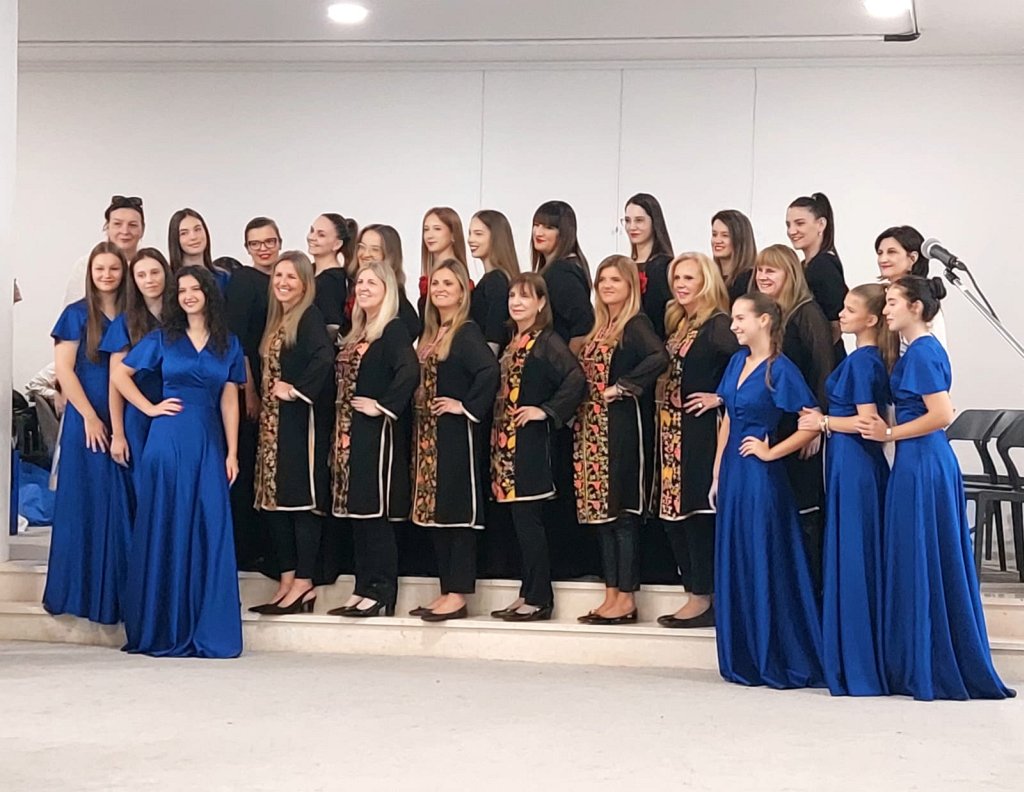
The women’s klapa “Valovi” from Argentina and friends gave a concert on October 7, 2026, at the Queen Katarina Gallery in the Croatian House of Herceg Stjepan Kosača in Mostar. The performance was part of a tour marking the 25th anniversary of the vocal group from Buenos Aires, bringing the Croatian diaspora community closer to the homeland of their ancestors.
The program also featured Mostar women’s klapas “Gratia” and “Lakrima.” “Gratia” performed three pieces and “Lakrima” two, while the guests from Argentina presented three pieces to the audience. HKUD “Rodoč” performed with its children’s group, which presented a children’s circle dance, and its singing group, which brought traditional songs from Herzegovina. The program was hosted by writer Anita Martinac.
For a quarter of a century, “Valovi” have nurtured and promoted traditional Croatian klapa singing in South America. The group is made up mainly of women descended from second- and third-generation Croatian emigrants, for whom song is a way to preserve their national and cultural identity and their strong ties to their ancestors’ homeland. The group currently has eight members. Although they were born in Argentina, they speak Croatian exceptionally well. The group also includes an Argentine woman who discovered and grew to love klapa singing by listening to “Valovi” performances.
Their musical style is based on arrangements of traditional Dalmatian klapa songs, traditional folk songs and popular Croatian compositions. Their repertoire is not limited to Croatian: they also perform arrangements of songs in Spanish and English. The Catholic News Agency (KTA) reports that the klapa has released several successful albums, particularly popular among Croatian emigrants and also in the homeland.
The klapa regularly takes part in cultural events organized by the Croatian community in Argentina. Over the 25 years of its activity, it has performed on numerous stages across the Americas and Europe; its appearances in Croatia include performances at the Dalmatian Klapa Festival in Omiš. This year’s anniversary tour in October included concerts in Split, Dugopolje, Bol on the island of Brač, Vitez, Posušje and Mostar, continuing to connect the diaspora and the homeland through song.
KTA describes the tour as exceptionally well attended and especially moving for the members. It was their first visit to Bosnia and Herzegovina, the country some of them come from. Maria Cecilia Fernandez Šarić, a member of the group, spoke to KTA about the klapa’s beginnings, its travels to date and the significance of this visit.
Recalling her musical involvement in the Croatian community in Argentina, Fernandez Šarić said that there was initially a mixed choir. After all the men left, it became a women’s klapa. She said that the members had traveled throughout Argentina and had also performed in Uruguay, Paraguay, Chile, Chicago and New Orleans. They had performed in Croatia three times, while this was their first visit to Bosnia and Herzegovina.
Speaking about their first visit to Bosnia and Herzegovina, she mentioned performances in Vitez, Posušje and Mostar, and noted in particular that they had also sung at the grave of Diva Grabovčeva. Fernandez Šarić said that they were able to make the anniversary tour thanks to the Croatian Heritage Foundation and the Office for Croats Outside the Republic of Croatia. She described the journey as the most beautiful of her life, saying that its special meaning was also connected to her own roots in Bosnia and Herzegovina, in the Livno region.
Fernandez Šarić is married to a Croat and regularly visits the homeland, but she spoke very emotionally about the experience of this tour. Reflecting on the klapa’s journey so far, she also expressed her belief that they would be able to bring together new generations of singers. She cited the large number of young people involved in folklore and arts groups as a reason for optimism. The members of “Valovi” also announced that new singers would soon join the current lineup.
For Fernandez Šarić, the value of these journeys lies not only in the performances, but also in the hospitality, encounters and relationships that remain after the concerts. “When we see how people applaud us, those of us who come from abroad, and how they follow us and welcome us, it makes us very happy and means a lot to us. It is not only about singing in Croatian, in Croatia and in Bosnia and Herzegovina, but also about all the ties that remain and all the time spent together. We are especially glad when we meet someone from our own community and discover details about our family,” she concluded in her conversation with KTA.