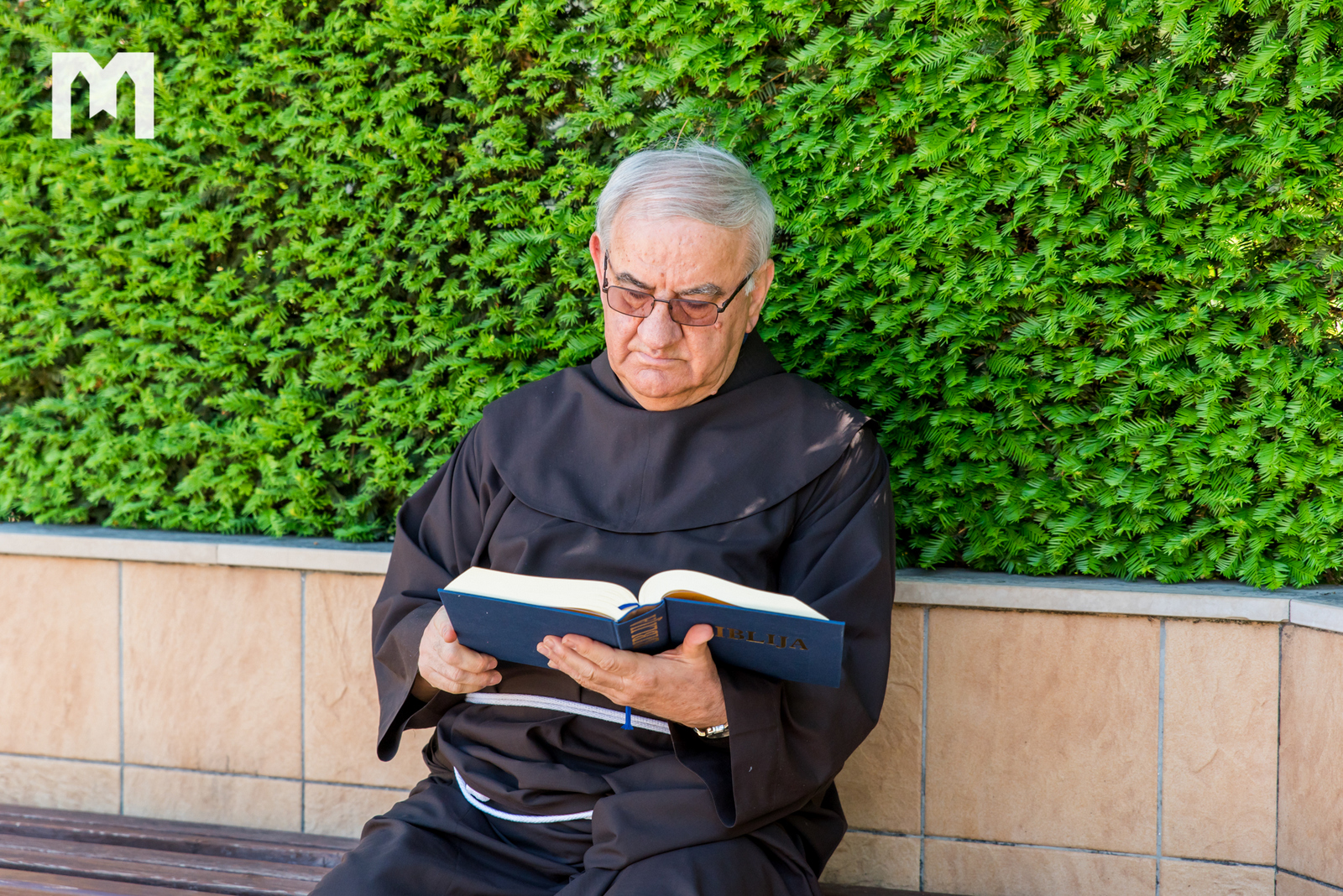
The Rosary is a summary of the Gospel and a “royal path of contemplation,” says Fr Tomislav Pervan in a reflection published by Radio Mir Međugorje on October 7, 2026, under the title “The Blessed Virgin Mary of the Rosary.” In the daily feature “Biblical Message of the Day,” where he has explained the Gospel for years, he speaks this time about a prayer that brings before the faithful the mysteries of Jesus’ and Mary’s lives and invites them to contemplate them through the eyes of Jesus’ Mother.
Fr Tomislav Pervan holds a doctorate and is the author of numerous books of theological reflection. He lives and works in Međugorje as the spiritual director of religious sisters, and also serves daily in the confessional. He is a former parish priest of Međugorje and former provincial of the Herzegovinian Franciscan Province. For years, he has written for Naša ognjišta, Katolički tjednik, Glasnik mira, MOVIS and other magazines and websites.
“Lord, teach us to pray”
The publication includes the Gospel passage Luke 11:1–4. After Jesus finishes praying, one of his disciples asks him: “Lord, teach us to pray, just as John taught his disciples!” Jesus replies: “When you pray, say: Father, hallowed be your name. Your kingdom come. Give us each day our daily bread. And forgive us our sins, for we ourselves forgive everyone indebted to us. And do not bring us to the time of trial!”
Pervan opens his reflection by recalling that October is the month of the Rosary. In this prayer, dear to the faithful, scenes from the lives of Jesus and Mary, and the mysteries of salvation and redemption, unfold before their eyes and in their minds, he writes. While the Gospels provide much information about Jesus’ life and death, far less is known about Mary’s fate after Pentecost. That is why, when reflecting on her later life, he turns to tradition, as well as to conjecture.
Mary as the Church’s living memory
He calls Mary the most influential woman in human history. He recounts the tradition that John the Evangelist took her to Ephesus, and places her death, as a conjecture, in Jerusalem around the year 50, at the time of the Council of the Apostles, perhaps somewhat before or after it. He links this dating to the apostles gathering again for deliberations, as recorded in the New Testament. He remains open to the possibility that John brought her from Ephesus, but also that she lived permanently in Jerusalem.
Reflecting on the origins of the Gospel accounts, Pervan suggests that Mary may have recounted events from her own life, while relatives or those close to her recorded her memories. He connects such narratives with the Haggadah, which he describes as storytelling with biblical material and a biblical framework, with legendary elements but a historical core. He supposes that Luke, while investigating sources for his Gospel, may have encountered documentation originating in Mary’s testimony and incorporated it into his text.
He dwells in particular on Luke’s words that Mary carefully kept these events in her heart and pondered them. In his interpretation, this is not storage in a dead archive, but a living memory from which the Church still draws life today. Mary, he notes, did not immediately understand the meaning of everything she experienced either. She wondered what each episode meant, and only in the light of later events could she connect her experiences into a whole, like assembling a mosaic.
In these expressions of Luke’s, Pervan sees a reference to Mary as a witness to the Annunciation, the birth in Bethlehem, the arrival of the shepherds and her meeting with Elizabeth. He believes the evangelist wants to show that he is passing on not merely a story or speculation, but testimony about events. In this sense, he figuratively calls her the “co-author of Luke’s Gospel” and the Church’s living memory, an expression that he also associates in his reflection with the late pope.
Pervan connects Mary’s presence in the upper room on Pentecost with the reception of the Holy Spirit and the birth of a new people of God. He describes this event as a great upheaval in human history, without which, in his view, we would not have the Bible as part of our cultural heritage today. He then conjectures that about twenty years later Mary was again in the same place for the Council of the Apostles, and that she may even have died there. He imagines her rejoicing that her Son’s work was continuing and his blessing spreading to the nations.
Mary, he continues, proclaims not only through her words, but through her life, death and glorification. Her example is understood by immersing oneself in scenes from her life and Jesus’ life. Pervan wonders how the mother of the Son condemned to the shameful death of the cross could have felt before the public. He describes her later life as an inner exile and a “martyrdom of love,” marked by her Son’s fate. For him, Mother and Son are inseparable, especially in suffering and love. Alongside the tradition of her death in Jerusalem, he mentions the Church of the Dormition of Mary in the Garden of Gethsemane, across the Kidron Valley.
From suffering to heavenly glory
Pervan goes on to describe Mary as the first and most excellent among the saints and expresses the belief that she is in heavenly glory, body and soul. As an argument for her Assumption, he cites the absence of bodily remains for the faithful to venerate. He compares this with the relics of apostles, martyrs and other saints, whose remains are kept in reliquaries. He argues that not the smallest bodily relic of Mary is offered—not even a lock of hair—while mentioning something of her clothing as a possible exception.
He goes further: despite the historical fervour for relics, and even their forgery, he claims that no bodily relics of Mary were offered. In his own theological argument, he calls this absence external evidence of the Assumption and connects it with a belief which, he writes, the faithful have accepted from the beginning. His starting point is faith in Mary’s heavenly glorification; the comparison with the veneration of other saints’ remains is part of his interpretation of that faith.
He calls Mary’s Assumption the culmination and completion of salvation history and the culmination of biblical anthropology, the teaching about the human person. He also points to the façades of European cathedrals, highlighting the Coronation of Mary as their central motif, that is, a depiction of the completion of her life in heavenly glory. At the heart of his reflection remains the connection between suffering and glorification: the God who allowed Mary to be with her Son at the cross, right beside his agony and death, is the same God who glorified her. He therefore describes her heavenly glorification as a profoundly reasonable and humane feast, and these mysteries are also contemplated in the Rosary.
The Rosary and the Holy Land
Pervan firmly connects the Rosary with the Holy Land, especially Jerusalem, which he calls the “city of the Rosary.” The prayer’s mysteries have their places in Jesus’ earthly life: his birth in nearby Bethlehem, his presentation in the Temple and his finding there, and the events of his Passion and glorification. He sees this connection between prayer and specific places as the reason every Rosary leads the faithful in spirit to Jerusalem.
The Mysteries of Light, a gift from the holy pope to the Church and those who pray, have an important place in the reflection. Pervan recalls that for centuries the Rosary was called the people’s psalter for the illiterate and uneducated: its 150 Hail Marys corresponded to the 150 psalms. With the addition of the Mysteries of Light, he speaks of the four parts of the Rosary as corresponding to the four evangelists. In this way, according to his interpretation, the prayer gains a fuller Gospel framework.
Using an image borrowed from physics, he calls this shift a “quantum leap” towards something new, from the Old Testament to the New, from the psalter to the Gospels. He sees the pope’s intention as enabling the faithful to contemplate Jesus Christ with the eyes, heart and whole being of his Mother. He also recalls Jesus’ words to Philip: “Whoever has seen me has seen the Father.” In this reflection, the Rosary is a means of consecrating one’s life, a simple string of beads from which spiritual joy and strength flow, and a path to Jesus, the tabernacle and the Eucharist, which he calls the essential mystery of faith and an unfathomable treasure.
Pervan calls the Mysteries of Light the pope’s most cherished legacy, a lasting memorial preserved in a simple prayer. He expresses his conviction that people will remember this gift even half a millennium from now. By way of comparison, he says that the events of the 20th century will become a distant past for future generations, like the Mongol invasion of Europe or the French Revolution. In contrast to that historical distance, he believes, living prayer will remain, along with the memory of the pope who enriched it with the Mysteries of Light.
Twenty mysteries, twenty Gospel scenes
“The Rosary is a summary of the Gospel,” Pervan writes. Scenes from Jesus’ life unfold before the person praying, and the prayer enables them, figuratively speaking, to breathe in the mysteries and live with them. That is why he calls it a royal path of contemplation and Mary’s way of prayer. He explains why he considers the gaze of Jesus’ Mother the path to contemplating Christ’s life by asking who knows and loves Jesus better than his Mother.
He interprets the rosary as a “rose garden,” a space for contemplation that brings a new way of seeing the world. In each part, he says, five icons, or images from salvation history, are contemplated. The twenty mysteries in all thus represent twenty key Gospel moments through which one seeks to grasp the reality of Jesus’ person, God among people, through the eyes of his Mother. He also recalls the expression that icons are not painted but written, and calls their creators iconographers. In his description, understanding deepens through an ongoing gaze fixed on Christ.
He also compares the Rosary to looking through a keyhole, which opens up new realities and enables one to see more deeply and farther. He calls it theology framed by prayer, accessible not only to theology students. Such prayer, he stresses, is not chatter, but an entering into the mystery; its gaze does not take things apart or separate them, but connects and brings them together. “Theology on one’s knees” does not reject reason, but liberates it. The image of Braille further helps him describe how the beads sliding beneath the fingers do not turn either the eyes or the mind away from contemplation.
For Pervan, each decade of the Rosary is a little pilgrimage to Jesus’ land, an entry into the life of Mary and Jesus. The prayer thus connects Christian daily life with the Holy Land and its holy places. He compares its simplicity and the gradual discovery of its sweetness to bread in the mouth: the longer one chews it and allows it to dissolve, the more its sweetness can be tasted. So, he believes, repetition makes the Rosary sweeter in the mouth and heart, while its mysteries become ever more deeply embedded in the life of the person praying.
Regular prayer, not a rigid rule
Pervan encourages a steady and regular practice of the Rosary, convinced that it changes life. He does not prescribe one obligatory rhythm: it can be prayed more slowly or more quickly. He gives twenty minutes for five mysteries as a suitable guideline, but immediately adds that prayer can take longer or less time. The emphasis of his encouragement is not on strictly measuring the time, but on praying regularly.
He recounts a story that the beads of the Rosary slipped through Padre Pio’s fingers like fish. He does not present the Rosary as a law or canon, but as a park, a garden where a person dwells, walks and discovers what they do not yet know. In the same spirit, he cites a pious saying that if a person falls asleep with the Rosary in their hand, the angels continue praying in their place. These images serve his encouragement to pray in a way that is not reduced to rigidity and measurement.
The most important thing, he emphasizes, is not to stop praying. He compares perseverance to a shaken boxer gripping the ropes in the ring. He attributes spiritual consecration, rest, peace and freedom from fear in the soul to the Rosary. In his words, it does not take time away, but gives it. He sums up his encouragement with the thought that there is no need to change the prayer itself: the prayer of the Rosary changes the person praying.
Alongside the meaning of the Rosary as a crown and garland, Pervan also turns to an image from art. He mentions a detail in Michelangelo’s “The Last Judgment” in the Sistine Chapel, which he describes as a scene in which the Rosary pulls a person out of a hellish abyss. With this image, too, he continues his reflection on the meaning of the Rosary in the life of the faithful.
At the end, he recalls that the Rosary can be prayed anywhere: alone or in a community, in a vehicle or on a bus, while walking or travelling, in a crowd or a waiting room, in silence, in joy and in hardship. He describes it as a prayer that eases nervousness, leads to peace and rest and, figuratively, waters the parched soil of life and drives away fear. The reflection concludes by connecting life and death: the Rosary is placed together with the cross in the folded hands of the deceased. For Pervan, it thus remains a sign of connection with our loved ones, with dear ones, in life and in death.