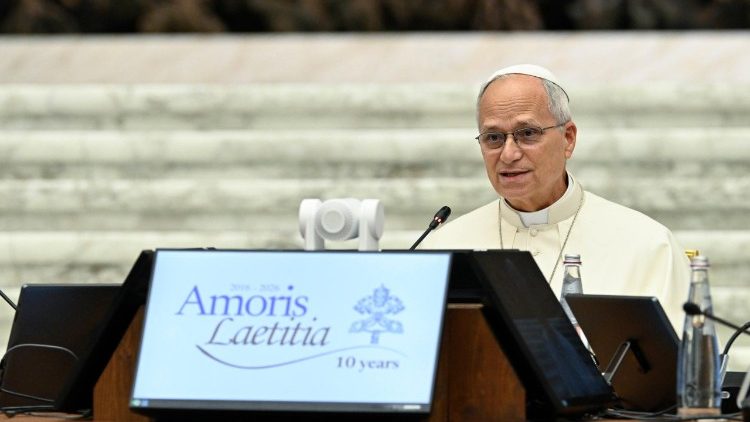
Pope Leo XIV opened a gathering in the Vatican on Wednesday, 7 October 2026, marking the tenth anniversary of the publication of the apostolic exhortation *Amoris laetitia*. He called on participants to listen attentively and deeply to families and to address courageously the questions their lives pose to the Church. He particularly stressed the need to remain close to people in experiences of vulnerability, wounds and apparent failures.
The gathering, which runs from 7 to 14 October, brings together leaders of the Eastern Churches, presidents of bishops’ conferences, married couples and various experts. As the Catholic News Agency reports, citing Vatican News, participants are reflecting on the family in the light of Pope Francis’s exhortation, which grew out of the two Synods on the Family held in 2014 and 2015.
Listening to families in changed circumstances
“Ten Years after *Amoris laetitia*: Proclaiming the Gospel with Families Today” is the title and theme of the gathering, which began in the Paul VI Audience Hall. Its work is designed according to a synodal model: alongside testimonies, meditations and presentations, it includes conversations, group work and moments of prayer. The Pope connected this kind of listening with the need for the Church to respond to families living in circumstances considerably different from those of ten years ago.
“Their lives also raise questions that we need to address courageously. In many settings, an increasing gap has become evident between the ways sexuality and intimacy are lived and the Christian understanding of marriage,” Leo XIV said. He encouraged participants to truly listen to families’ questions so that they could respond to them.
Among the guidelines for the gathering, the Pope stressed discretion and confidentiality, as befits such an event. He also reflected on its broader ecclesial context, placing it within the Church’s long and fruitful synodal and missionary journey and its enduring attention to marriage and the family. He connected the Second Vatican Council, the post-synodal apostolic exhortation *Familiaris Consortio* of Saint John Paul II, and the exhortation *Amoris laetitia*.
He recalled that the Council Fathers recognised family life as a privileged way of approaching major cultural, economic, social and political questions, including the promotion of peace among peoples. He presented *Amoris laetitia* as an important stage in the synodal process initiated by Pope Francis so that the Church could continue its discernment in the face of profound changes. This history spanning half a century, he stressed, gives the gathering and pastors a particular responsibility.
Reflecting on the past ten years, Leo XIV said that, in embracing *Amoris laetitia*, the Church had journeyed with families in different circumstances. It had gathered their questions and stories of conversion, unexpected fruits and relationships, while also facing difficulties and new questions. “Let us place them before the Lord and share them with one another, seeking to recognise what God is doing among us and where his Spirit is leading the Church today,” he urged the participants.
Young people, lifelong commitment and the challenges of real life
The Pope turned in particular to young people who, he said, continue to long for love, fidelity and a sense of belonging. Yet they often find it difficult to understand how to make this vision of love a reality in their own lives, or to believe that a lifelong commitment is a condition for what they long for. “Economic insecurity, migration, violence, loneliness and other forms of emotional vulnerability also affect the choices people make and the possibilities they can imagine for their future,” he warned.
He therefore called on bishops to consider the concrete circumstances in which people live. He recalled pastors’ responsibility to proclaim, in season and out of season, the beauty of God’s plan for marriage and the family and his call to love and tenderness. The wisdom of the People of God, he stressed, helps meet this challenge by shedding light even on situations marked by difficulties, loneliness and apparent failures. The Church, he emphasised, has much to learn from families.
He proposed a series of questions for discussion and reflection: “What are people really seeking amid these cultural changes? What do their joys and hopes, their griefs and anxieties reveal to us? In which areas do our language and pastoral practices succeed in opening a way, and in which do they fail to touch people’s hearts or support their efforts to do good?”
He then turned the questions to the experience of families themselves and to their formation: “What does the lived experience of families teach us—what is there in that experience that we have not yet fully learned? What formation can we offer for a healthy and holy family life? What can we learn from parents who are trying to accompany their children and young people in circumstances such as these?”
What kind of Church do the most vulnerable encounter?
The Pope devoted particular attention to vulnerability, which, he stressed, can deeply shape the way people see themselves, their future and even their relationship with God and the Church. “The experience of vulnerability raises the question of whether we are capable of remaining close to one another when life no longer matches what we had hoped for, and whether we can recognise the action of grace even in situations marked by limitations, wounds and apparent failures,” he said.
The experience of families, he continued, can teach the Church a great deal in this regard, too. Vulnerability is not an isolated experience but part of the shared human condition and, therefore, of the life of the Church. In this context, he raised questions about pastoral presence: “What kind of Church, then, do people encounter precisely when they are most vulnerable? Can the truth we proclaim be encountered through the patience, closeness and mercy of our pastoral presence? How can we proclaim the fullness of the Gospel teaching on the family?”
The coming days of the gathering, the Pope said, offer an opportunity to reflect on these questions. The Church’s task is not only to interpret the reality of families, but also to allow them to challenge her and prompt her pastoral responsibility. In this way, she can seek renewed ways of proclaiming the Gospel. He invited participants to bring the experiences of their Churches into the conversation, both what had brought them joy and what had put them to the test.
“We can share what has brought joy to our Churches, what has put us to the test, and which questions have emerged more clearly through experience. What is more, the diversity of the circumstances from which we come can become a gift for the discernment of the whole Church,” Leo XIV said.
Gathering the fruits of ten years of *Amoris laetitia*
The Pope asked participants to discuss how their Churches had lived out what *Amoris laetitia* proposes over the past ten years. He expressed hope that the pastoral creativity needed to face new questions would be awakened. He also asked the Lord to help gather the fruits the exhortation had borne in local Churches, so that they could nourish the whole Church.
“I hope that, through the many testimonies you bring from your Churches and from different cultural settings, a shared account of these ten years, marked by joy and hope, can gradually take shape—one that could enable us to face honestly the challenges and difficulties that remain,” the Holy Father said.
Such work, Pope Leo XIV concluded, will help local Churches recognise new paths and involve all the baptised more deeply in the Church’s synodal journey.