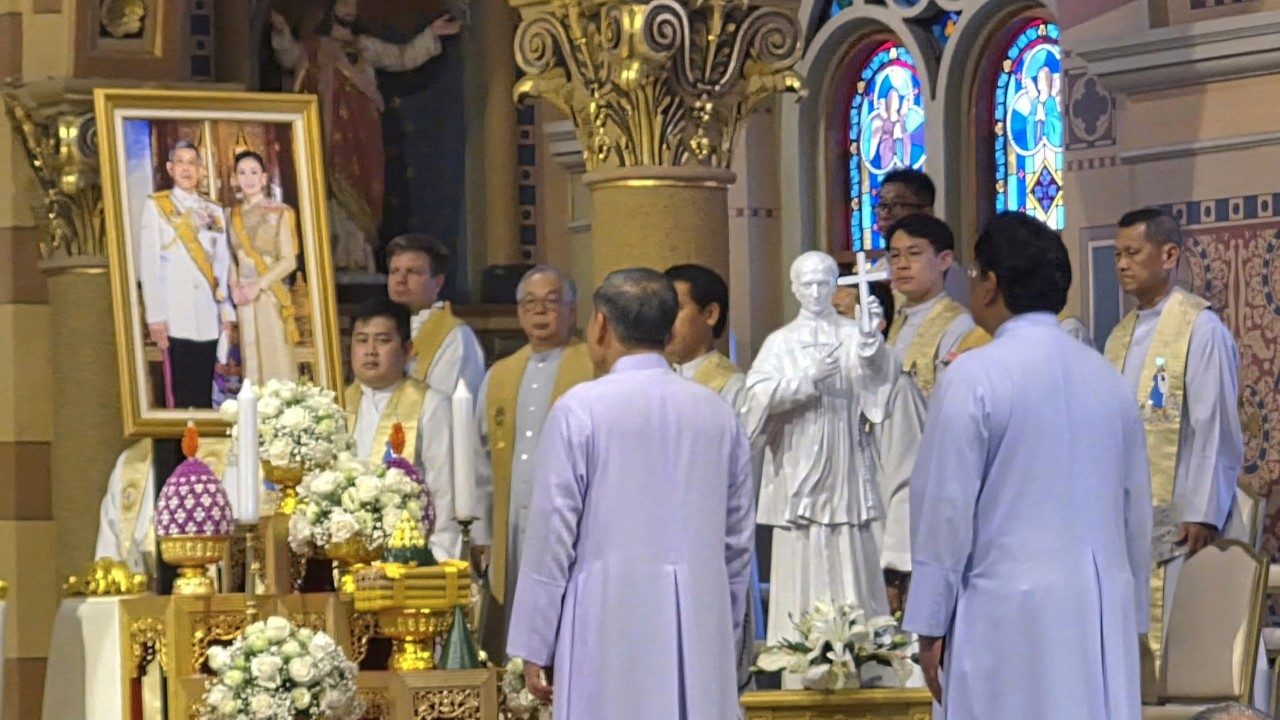
With a Mass of thanksgiving in the Cathedral of the Assumption in Bangkok on October 7, 2026, the Brothers of St. Gabriel marked 125 years of educational work in Thailand. Their mission, focused on education and the integral formation of the person in the spirit of St. Louis-Marie Grignion de Montfort, began with the arrival of five missionaries from France, who were brought to Siam by the passenger ship *Annam*.
The Mass was celebrated by Bishop Silvio Siripong Charatsri, with the Apostolic Nuncio to Thailand, Archbishop Peter B. Wells, among the concelebrants. Bishops, brothers, priests and other religious, educators, former students and student representatives took part in the celebration.
King Maha Vajiralongkorn sent a message of congratulations for the 125th anniversary. “As the Brothers of St. Gabriel in Thailand mark the 125th anniversary of their enduring mission of education and formation for young people, I wish to express my sincere admiration and extend my best wishes. May your organization successfully fulfil its mission, bringing ever greater and more widespread benefit,” the king said.
Queen Suthida, who graduated in communication arts from Assumption University in Thailand in 2000, also reflected on the congregation’s contribution to education. She presented a pair of royal candles for the Eucharistic celebration. She noted that the brothers have long been dedicated to providing education and raising academic standards, from early childhood through higher education. In this way, she said, they play an important role in forming people of quality, who are among the country’s key driving forces.
From the arrival of five brothers to an educational network
The congregation’s presence in Thailand began in October 1901, at the invitation of Father Émile Auguste Colombet, founder of Collège de l’Assomption, also known as Assumption College. Seeking to raise the school’s standards, Father Colombet entrusted its management to the French brothers. The community was led by Brother Martin de Tours, FSG, and among the brothers who laid the foundations of the future educational network was Brother Hilaire, author of the Thai-language textbook *Darunsuksa*.
After the First World War, growing demand for education prompted further expansion. In 1922, the brothers founded Saint Gabriel’s College in Bangkok’s Samsen district, and in 1932, Montfort College in Chiang Mai. The St. Gabriel’s Foundation in Thailand was established in 1937 to make management more efficient and separate pastoral life from civil administration.
In the following decades, the network expanded into higher education through Assumption Business Administration College, known by the acronym ABAC. It later became Assumption University in Thailand, the country’s first international university. In this way, educational work that began with taking over the management of a school came to include the university level.
Scholarships and reflection on technological change
The anniversary program brought together academic and spiritual activities over the course of a week. On October 5, “FSG Academic Expo 2026” was held at Assumption College, where the Brother Louis Chanel Foundation awarded scholarships. A total of 900,000 baht was allocated to support gifted students facing financial difficulties in the network of Catholic schools throughout Thailand.
The following day, October 6, Superior General Brother Dionigi Taffarello convened a management seminar attended by leaders of 16 institutions affiliated with the foundation. The discussion focused on the challenges of artificial intelligence and rapid technological change. Participants reflected on the relationship between modernization and spiritual values.
Wells: Preserve not only institutions, but also spiritual integrity
During the liturgy, Archbishop Wells spoke about the congregation’s enduring mission. “An anniversary is not only a celebration of time passed, but also of lives transformed through education. The brothers’ work is woven into the formation of young people, the trust of families and the vocation of educators… The future demands more than preserving institutions: it requires preserving spiritual integrity and unity,” the nuncio said.
At the end of the Mass, Brother Dionigi reflected on the relationship the congregation has built with Thai society over the decades. He made particular mention of families, educators, former students and the local Church. “The first five brothers brought with them the Gospel, trust in God’s providence and a spirit of service,” he said. “In return, Thailand shaped the brothers, incorporating its culture and generosity into the congregation’s identity.”
The Superior General invited the community to move into the future with gratitude, maturity and renewed generosity. He again emphasized that the educational mission is centered on the human person and occupies a central place in the work of the Church.
The Thai provincial, Brother Dr. Surakit Srisarankulwong, FSG, also expressed gratitude to the educational community. He said that while artificial intelligence and modern technologies are changing human relationships and ways of learning, the network remains committed to educating students of strong character and firm moral foundations. His message emphasized the continuing importance of forming the person amid technological change.
Generations of students in public life
During 125 years of work, the foundation’s institutions educated generations of students who later took on roles in public life. Among the alumni of the Assumption family, the source names former prime ministers Phraya Manopakorn Nitithada, Thaksin Shinawatra and Samak Sundaravej, as well as Prime Minister Anutin Charnvirakul and General Surayud Chulanont, president of the Privy Council.
Alongside gratitude for the work accomplished so far, the anniversary messages also looked to the future: Brother Dionigi called for renewed generosity in the educational mission, while Provincial Surakit urged perseverance in forming character and moral foundations. Archbishop Wells noted that the future requires not only the preservation of institutions but also their spiritual integrity and unity.