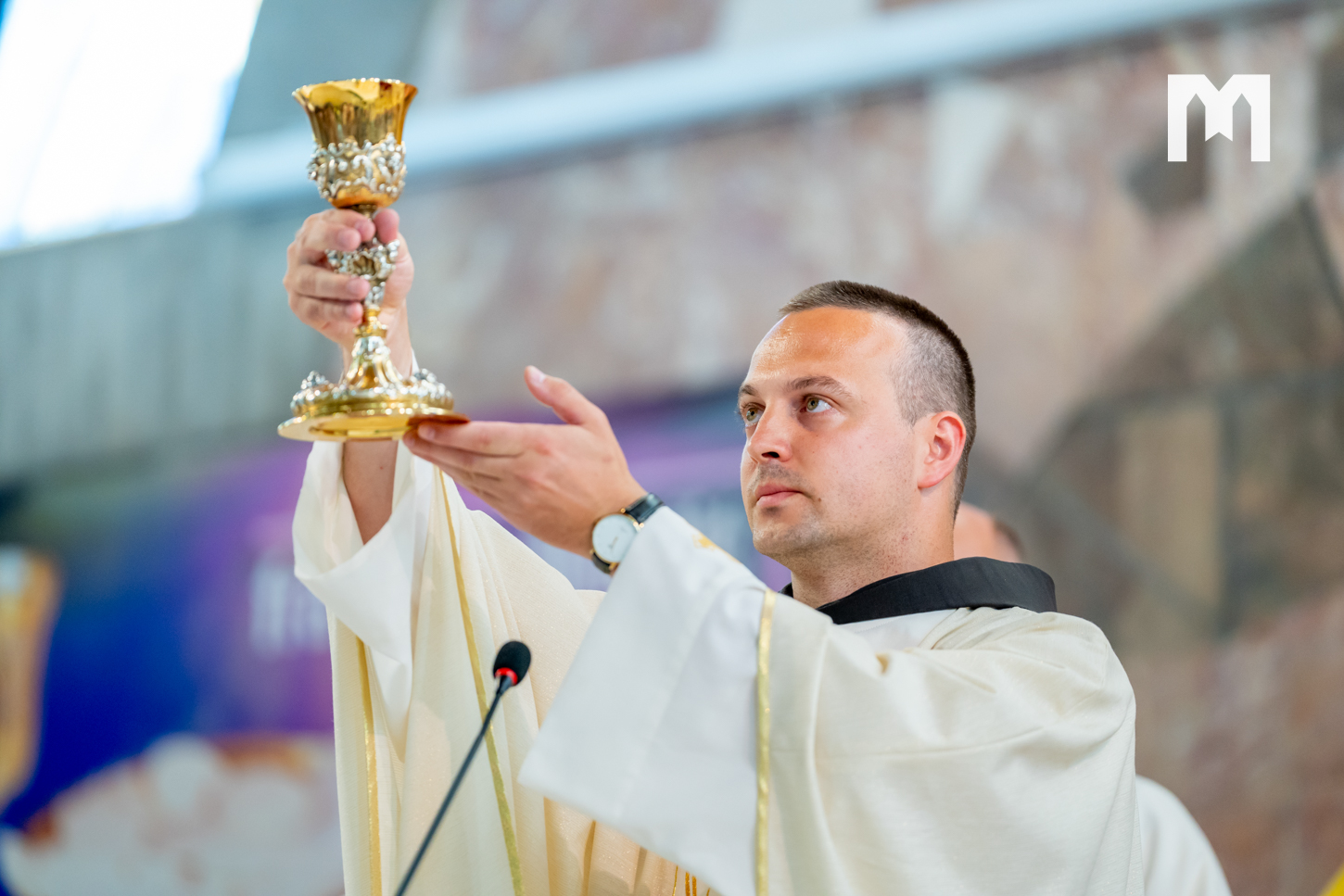
According to Fra Marin Mikulić, the line between moderation and excess in drinking is not primarily a matter of how many glasses a person has consumed, but of the ability to exercise self-control and know when to stop. He spoke about this on Radio Mir Međugorje’s “Ask a Priest” segment, answering a listener who asked how that line can be defined, given that wine and vineyards are often mentioned in the Bible.
Radio Mir Međugorje published the answer on September 29, 2026. Fra Marin, a priest of the Herzegovinian Franciscan Province and a parish vicar at the parish of St Stephen the First Martyr in Čerin, began by emphasizing that the line can be defined. He also recalled the use of wine in the Holy Eucharist, where, as he said, it is transformed into the blood of Christ.
Wine in itself is not a sin
“The Bible nowhere says that wine in itself is a sin,” Fra Marin said, citing Jesus’ turning water into wine at a wedding as an example of a positive attitude toward wine. At the same time, he pointed to the words from the Letter to the Ephesians: “Do not get drunk on wine” (Eph 5:18). Drunkenness, he stressed, deprives a person of freedom, reason, and self-control.
“And so the line is not whether someone has had one, two, three, or four glasses, but whether the person can still exercise self-control afterward,” he explained. In his interpretation, excess begins when a person no longer knows when to stop. He gave as an example someone who feels the alcohol is already affecting them but nevertheless keeps drinking and moves toward drunkenness.
Speaking about differences between people, he compared a person who notices no effects after five glasses with another who feels them after just two. The emphasis in his answer was on recognizing one’s own limit and deciding to stop: “No, this is enough for me; I mustn’t have any more; something bad could happen.” He called crossing that line a sin and warned that a person who is drunk may commit additional sins as well.
Drinking contests and loss of control
Fra Marin also addressed competition in excess, in drinking as well as in other things. He particularly criticized the habit among men of trying to demonstrate their masculinity by how much alcohol they drink. Such contests in getting drunk, he warned, can end in conflicts and arguments.
He went on to speak about addictions, mentioning food, drink, and drugs. He stressed that once a person falls into addiction, it is difficult to get out of it alone, which is why many people also go for treatment for alcohol addiction. For that reason, he said, it is important to set limits from the outset and ask whether a person can control themselves, remain composed, and determine how much is enough for them.
“A person always tends in some way toward that pleasure,” he observed, linking enjoyment of alcohol with enjoyment of food and the desire to drink or eat a great deal. In this context, he recommended the fast prescribed by the Church, describing it as a practice in self-denial and self-control.
Fasting as a practice in setting limits
Fra Marin also referred to Our Lady’s call to fast at least twice a week, on Wednesdays and Fridays. “Fasting teaches us self-denial,” he said, explaining that through self-denial one learns to keep one’s desires under control. Whether the decision is to fast for one or two days, he described success in doing so as an indication of one’s ability to exercise self-control and regulate one’s relationship with food.
He contrasted this with the availability of food today: people can choose what they eat, and can even order food without going to a shop. It is precisely in this enjoyment, he warned, that a person can cross the line into excess in eating and drinking. He therefore sees fasting as a way of learning self-denial and setting limits—that is, developing the ability to say consciously: “No, I won’t; today I’m doing it this way.”
Concluding his answer, Fra Marin returned to the biblical example. He said that Jesus also drank wine, but that nowhere do we read that he got drunk, thereby emphasizing his message that moderation is possible. His full answer is available in the audio recording accompanying Radio Mir Međugorje’s original post.
The “Ask a Priest” segment, in which priests who collaborate with Radio Mir Međugorje answer listeners’ questions, airs on Mondays at 8.20, with a repeat on the same day at 20.15. Questions can be sent by SMS, Viber, or WhatsApp to **00387 63 455 655**.