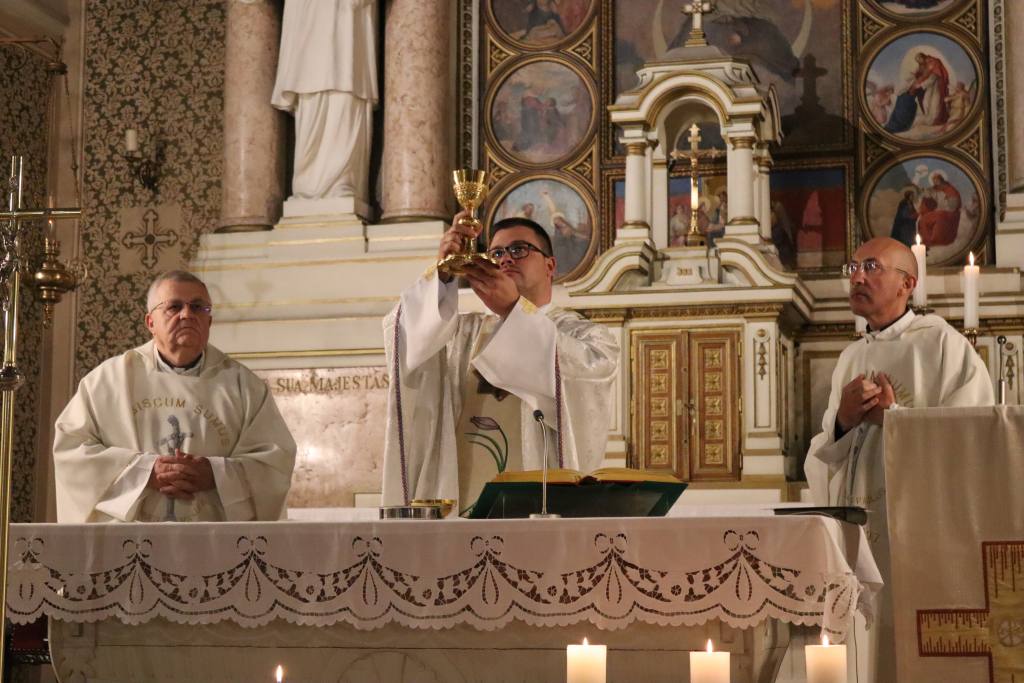
On Wednesday, 7 October 2026, the feast of Our Lady of the Rosary, the Sisters of the Congregation of the Daughters of Divine Charity celebrated the patronal feast of their convent church, Our Lady of the Holy Rosary, on Banj Brijeg in Sarajevo. The solemn Eucharistic celebration took place in a church that is also a special place of devotion to the Blessed Drina Martyrs, the Catholic News Agency reported.
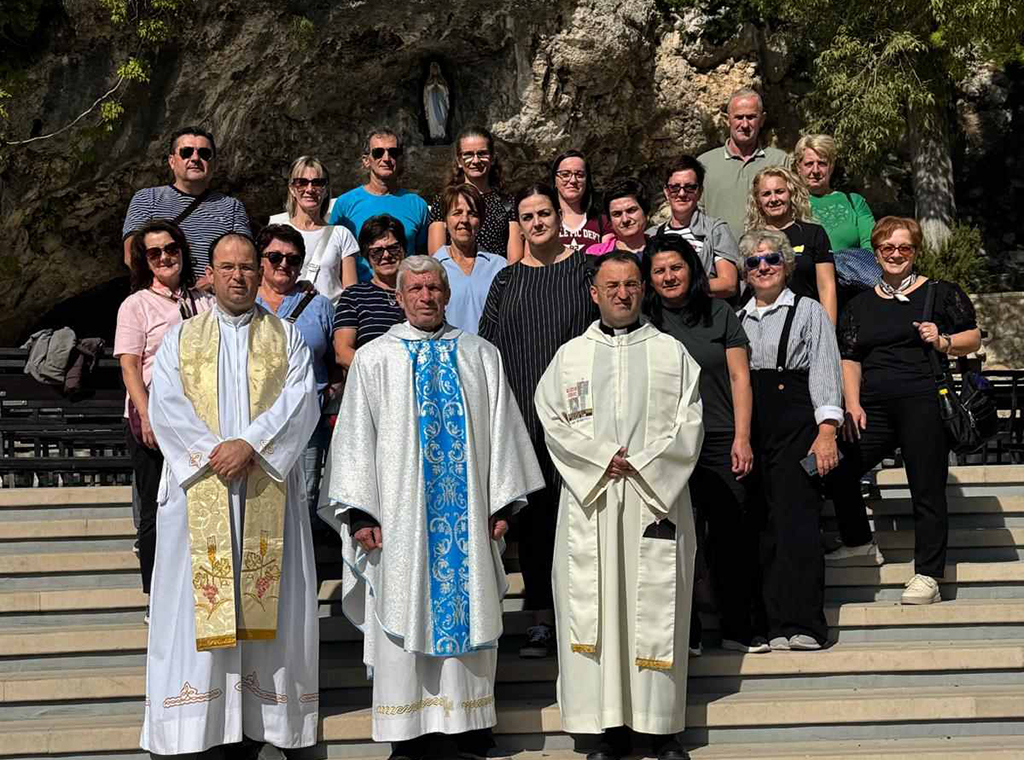
The evening Mass, concelebrated by eight priests, was presided over by Fr. Vedran Ćosić, rector of the Church of Our Lady of the Holy Rosary and director of the boarding school at the St. Joseph Catholic School Centre in Sarajevo. Along with the faithful who had gathered, around thirty religious sisters took part: Sisters of the Daughters of Divine Charity and members of other religious communities serving in the capital of Bosnia and Herzegovina. The choir of seminarians from the Vrhbosna Major Seminary, conducted by Fr. Ivan Raka, led the liturgical singing.
At the beginning of the celebration, Fr. Ćosić welcomed the Sisters of the Daughters of Divine Charity, together with their superior, Sr. Fidelis Lučić; the seminarians, led by the rector of the Vrhbosna Major Seminary, Very Rev. Ivan Raka; the priests; the religious sisters from other communities; and the gathered people of God. He recalled that they had come together to celebrate the heavenly patroness of the Church of Our Lady of the Holy Rosary, and noted that the church is also a public oratory to which many generations are connected.
Three scenes and a message of God’s nearness
In his homily, Fr. Ćosić brought together three biblical scenes: ruined Zion, Nazareth and the upper room in Jerusalem. Through them, he said, we can reflect on what a person carries within. He summed up their shared message in the words: “God comes and dwells among us.” This thought connected his reflection on ruins, fear, silence and praying together.
Reflecting on the prophet Zechariah, the preacher described a people returning from exile: weary and frightened people who had left behind a ruined temple and crumbling walls and were now wondering whether they themselves were to blame for what had happened to them. God, he stressed, does not make them first put everything right as a condition. Instead, he says: “Shout for joy and be glad, daughter Zion, for I am coming to dwell among you.” In Ćosić’s interpretation, this message reveals precisely a God who comes and remains amid the ruins.
He connected this scene with the often deeply rooted belief that a person is worthy of love only when they are good, proper, successful and perfect. He warned that a person can carry this image into their relationship with God as well, thinking that they may draw near to him only after they have put everything in order within themselves. “Zechariah’s words overturn that very image, because God does not wait for our inner life to become a perfect cathedral, decorated on the outside; instead, he makes his home even among the ruins,” Fr. Ćosić stressed.
In this context, he also spoke about encountering one’s own silence. In it, he said, unwept sadness, old anger and fears that a person has not yet named can surface. He thus linked silence with what a person carries within but has not expressed or faced. “Anyone who is afraid of their own silence will find it difficult to hear God speaking in it,” he told those gathered.
Mary’s question, freedom and trust
The second scene in the homily was Nazareth and Mary’s encounter with the angel’s announcement. Ćosić noted that the Gospel does not conceal her human response: Mary was troubled and began to reflect. She did not suppress her unease or run away from it, but stayed with what she was feeling and thought about it. Mature faith, he stressed, is not the absence of fear, but the ability to look at one’s fear without letting it make decisions on one’s behalf.
He also recalled the angel’s words, “Do not be afraid, Mary,” and her question, “How can this be?” According to his interpretation, that question expresses not a lack of faith but honesty. He connected Mary’s reflection and question with the space that faith leaves for human reason and for what a person does not yet understand. “God can bear all our questions; he does not ask us to switch off our reason or remain silent about what we do not understand,” he said.
Reflecting on the angel’s answer, “The Holy Spirit will come upon you, and the power of the Most High will overshadow you,” he focused in particular on the word “overshadow.” He linked it with the cloud that shaded the tent of meeting in the wilderness, and also with the image of a mother shielding her child from rain, sun and wind with her own body. God, the preacher said, first creates a place of safety. Only in that safety can Mary freely say her “yes.”
From this he drew a message about faith, obedience and consecrated life: they should not mean silencing one’s own voice or suppressing what is alive within a person. “True obedience is Mary’s obedience, after questioning, freedom and trust,” Fr. Ćosić said. He added that Mary shows how “the greatest ‘yes’ in life can be spoken in a trembling voice and still be completely genuine.” In his reflection, then, Mary’s consent is not separate from her question and unease, but comes through freedom and trust.
A community where sorrow can be shared
The third scene was the upper room in Jerusalem. The preacher recalled the apostles who, after Jesus’ Ascension, neither scattered nor shut themselves away in their own grief. They gathered and remained “of one accord in prayer” with Mary, the mother of Jesus. Mary, he noted, had herself experienced the deepest loss and stood beneath the Cross, and he viewed her presence among the apostles in the light of that experience.
According to Ćosić, Mary did not take away the apostles’ pain, but through her calm presence made it bearable. He described her closeness as a maternal mission that does not mean removing every difficulty or suffering. “That is precisely the maternal mission: not to remove all suffering, but to be beside us so that suffering does not destroy us,” he stressed, speaking about the value of being steadfastly present to another person.
Among the apostles gathered there, he recalled, were Peter, who had denied Jesus; Thomas, who had doubted; and Simon the Zealot, a man of a fiery temperament. No one, he stressed, was excluded because of their past. His message was that the Church, religious communities, convents, parishes and families should be like this too: “an upper room where sorrow may be shared, not buried, where a wounded person does not have to pretend to be strong or brave.”
The rosary as an “upper room” we carry with us
Speaking about the prayer of the rosary, Fr. Ćosić compared it to a mother soothing a child to sleep by repeating the same melody and the same words in the same rhythm. “The repetition of the ‘Hail Mary’ calms a troubled heart, slows our breathing and brings us back to the present,” he said in his homily. He added that through the mysteries of Christ’s life, our own joys, crosses and hopes also enter into the prayer.
He also emphasized the bodily dimension of this prayer, in which the rosary beads are held in the hand. “The beads in our hand remind us that we pray with our whole being, body and soul,” he said. Connecting the prayer of the rosary with the earlier scene of the apostles and Mary in Jerusalem, he called it “an upper room that we can carry with us wherever we go.”
He illustrated the power of such prayer with a story about a grandmother who, during wartime, hid with several of her grandchildren in a cellar. As shells fell outside, the walls shook and the children cried, the grandmother had no answers or explanations, only the rosary. In the story recounted by the preacher, she sat among the children, took the youngest onto her lap and slowly began to pray. Gradually, the children stopped crying.
Ćosić also shared the words spoken many years later by one of the grandchildren: “I don’t remember the words Grandma prayed; I only remember that we weren’t alone in that cellar.” He concluded the story he had recounted with this memory of prayer and the grandmother’s presence among the frightened children.
At the end of his homily, he again brought together the scenes of the ruins, fear, silence and the upper room. He urged the faithful not to hide from their own hearts, to entrust their fear to God, and to be for one another what Mary was for the apostles. “May our heavenly patroness, dear brothers and sisters, teach us not to hide from our own hearts, to entrust our fear to the one who overshadows us, and to be for one another what she was for the apostles—a quiet, steadfast presence in which God can dwell,” he said.
At the end of the Mass, the church’s rector, Fr. Vedran Ćosić, thanked the priests, religious sisters, seminarians and faithful who had taken part in the patronal celebration. After Mass, the priests and faithful continued their gathering with the sisters of the Sarajevo community in the convent dining room.
A church connected with the Blessed Drina Martyrs
The Church of Our Lady of the Holy Rosary is part of the St. Joseph Institute complex, which today houses the Catholic School Centre. It was designed in 1909 by Josip pl. Vancaš and consecrated on 1 October 1911. The main altar was donated by Austro-Hungarian Emperor Franz Joseph during his visit to Bosnia and Herzegovina in 1910.
From 1920 to 1949, 274 Sisters of the Daughters of Divine Charity made their religious vows in this church. Among them were Sr. Jula Ivanišević and her four fellow sisters, who were killed in 1941 out of hatred for the faith, or *in odium fidei*, and are known as the Blessed Drina Martyrs. Because of this connection, the Church of Our Lady of the Holy Rosary is also a place of devotion to them.