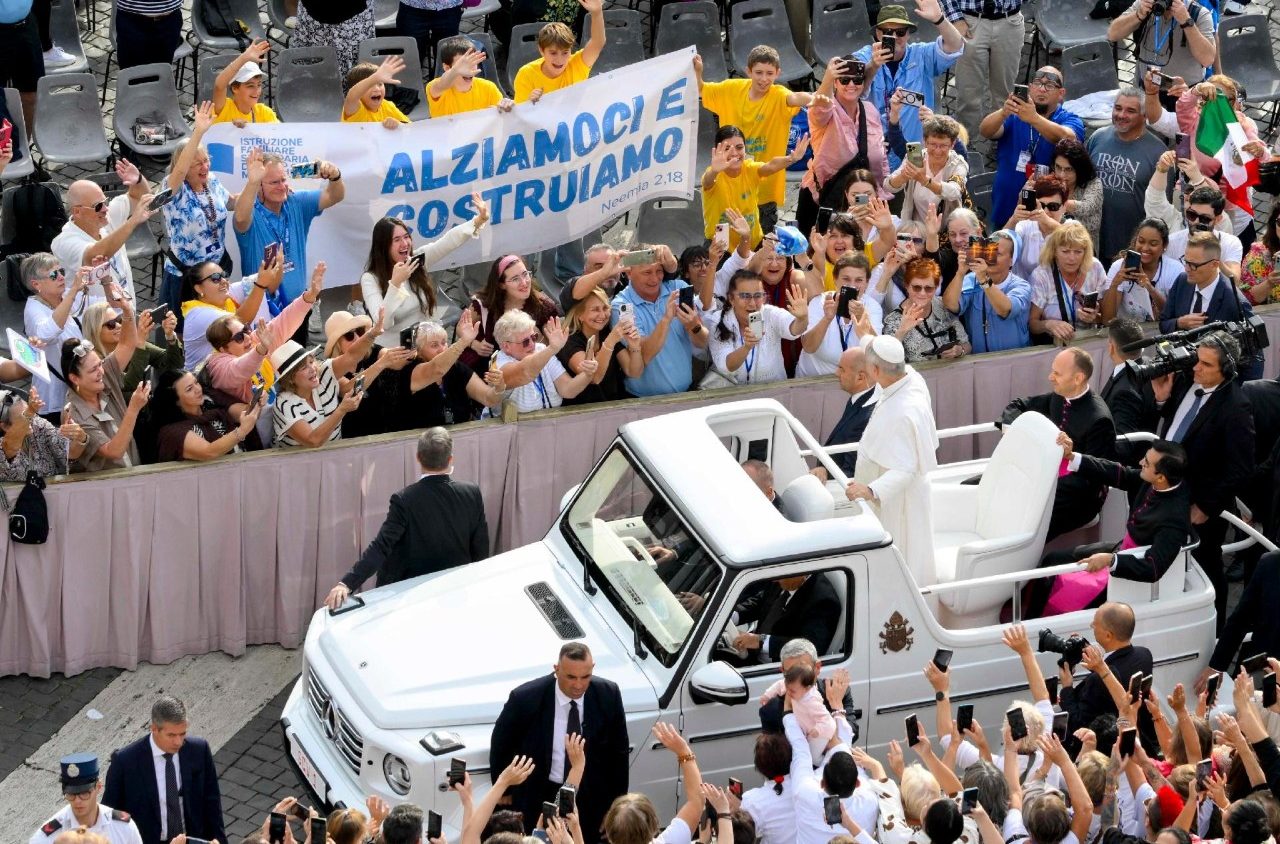
At the general audience on October 7, 2026, Pope Leo XIV said that a believer cannot accept the oppression of the little ones and the poor, or unjust structures that perpetuate dependency and injustice. Continuing his catecheses on the constitution *Gaudium et spes*, he stressed that the Church’s mission is carried out through the witness of faith and love, together with a commitment to justice, peace, and fraternity.
Following last week’s address, in which he reflected on his apostolic journey to France, the Pope returned to the fourth chapter of the first part of that conciliar constitution, which is devoted to the Church’s mission in the modern world.
The Church is not outside the world
Referring to the Council, Leo XIV recalled that the Church is neither “above” the world nor “beside” it, but is rooted within it. He described it as a world already reconciled with God, and stressed that we are pilgrims on earth who share this world’s fragility and beauty.
The Church’s first mission, he said, is to help people attend to life’s profound questions: where we come from and what our destiny is, and what love and suffering mean. He warned that the logic of profit at any cost and the manipulation of information can create undue pressure for people to adapt to a life focused on consuming material goods. “Our hearts were made to look upward,” he stressed.
He also recalled the Council’s teaching that the Church carries out its mission by contributing to the building of the earthly city. Its methods and purpose, however, are not primarily political in nature, but consist in bearing witness to faith and love and committing itself to justice, peace, and fraternity. In this context, he stressed that the oppression of the little ones and the poor, as well as structures that perpetuate injustice, are unacceptable.
The Church’s social teaching, the Pope continued, guides Christians in working with all people of good will to promote the common good. The Church is committed to serving the good of all people and to developing freely under any system that respects the fundamental rights of the person and the family and recognizes the demands of the common good.
Faith must be expressed in everyday life
For the evangelical mission to be carried out effectively, every baptized person is called to cooperate with the grace of the Holy Spirit, Leo XIV said. Faith must therefore be alive and expressed in consistent conduct. Referring to the Council Fathers, he warned that the gap between professed faith and everyday life should be counted among the gravest errors of our time.
He gave particular attention to the mission of the lay faithful, to which *Gaudium et spes* devotes special attention. By virtue of their baptism, laypeople are called to imbue the world with a Christian spirit and the outlook of the Gospel. The principal settings for this work—which, in the Pope’s words, can rightly be called priestly—are the family and professional life, but it encompasses every sphere of life.
Discernment without diluting the Gospel
The Church, the Pope stressed, is always attentive to what is happening and developing in society. It is the task of the entire People of God, especially pastors and theologians, to discern what in the cultures of our time deserves attention. The Word of God and the Tradition of the Church must remain the supreme standard for this discernment.
Such a task requires a balanced spirit, free from cultural fads, able to look positively at the world while firmly preserving and presenting the Gospel message in its fullness. “Christianity certainly cannot be made attractive by diluting its content and softening its demands,” Leo XIV warned.
Concluding the catechesis, he said that the Church has only one goal on its journey through history: the coming of the kingdom of God and the salvation of all humanity. The Church strives toward this goal, he stressed, above all through personal holiness and fraternal love.
He cited the words of Pope Saint Paul VI: “Without this mark of holiness, our words will have difficulty finding their way to the hearts of people in our time; on the contrary, they risk being futile and fruitless.” At the end, he invited the faithful to be docile to the action of the Holy Spirit, so that the Spirit may help them live in holiness and love, and the world may believe and hope.