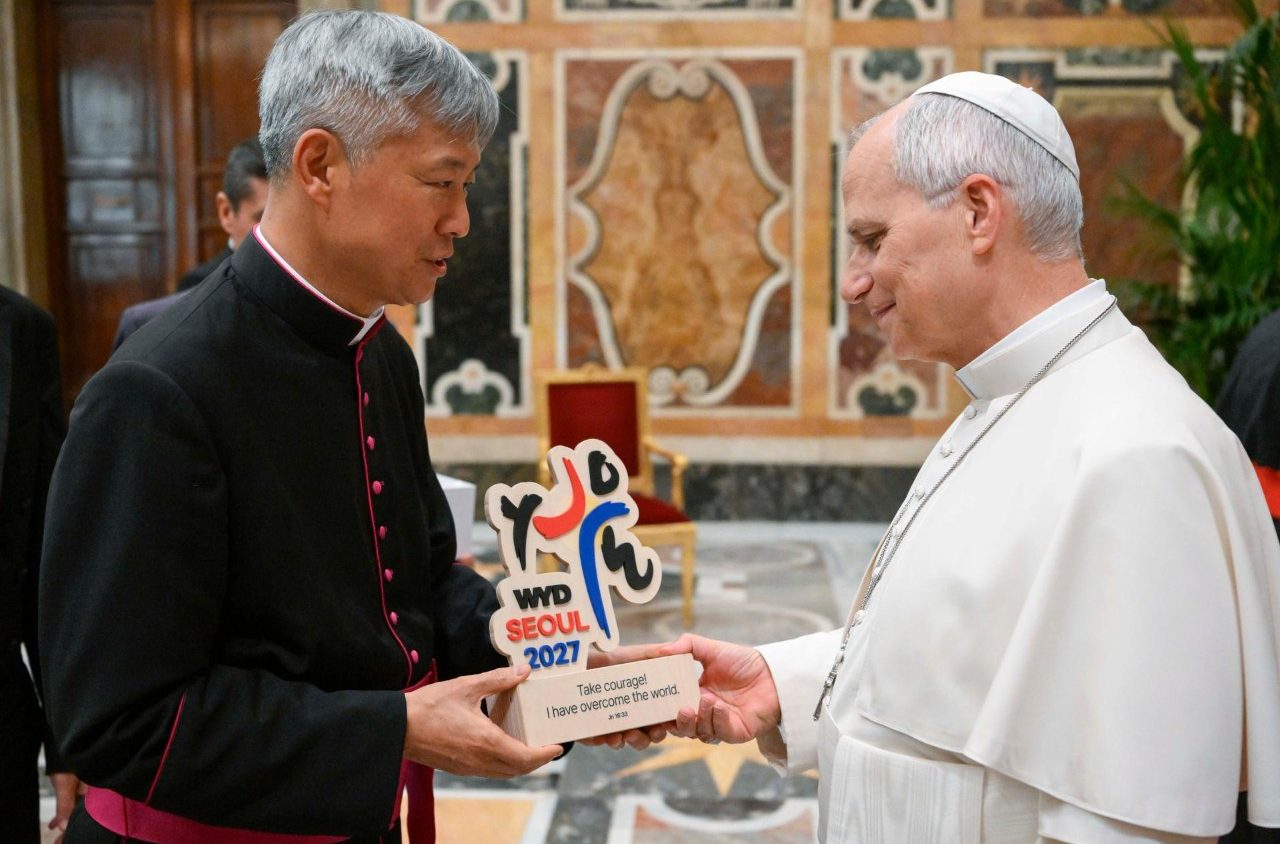
Pope Leo XIV received Korean priests, sisters and brothers who live in Rome in an audience on October 5, 2026, and called on them to be guardians of the memory of the Korean martyrs’ witness, witnesses of hope for young people, and builders of peace on the still painfully divided Korean Peninsula. Many of the 170 people present are involved in preparing World Youth Day in Seoul in 2027, as well as marking the 25th anniversary of the opening of the headquarters of the Pontifical Korean College.
Passing on the martyrs’ faith to new generations
“The faith you received in Korea can find a new missionary impetus here in Rome, where we keep alive the memory of the apostles Peter and Paul. You have come from far away, but here you are at home,” the Pope said. He recalled that Korea, once a mission country, has today become a homeland of missionaries, drawing on the memory of the martyrs’ faith and sacrifice. “Memory gives rise to mission, and mission opens us to hope,” he stressed.
In this light, he spoke about the next World Youth Day, when young people from every part of the world will come to a country where the Gospel grew through the witness of martyrs. He expressed his hope that the gathering in Seoul would be a great encounter of memory and the future: the martyrs hand on the faith to new generations, and young people receive it so that they can carry it along the paths of the world.
He invited everyone involved in preparing the gathering to listen to young people and walk with them. Their task, he said, is to help young people discover that following Christ does not diminish freedom but makes it complete, and that faith does not narrow life but opens a wider horizon for it. He encouraged them to prepare wholeheartedly, with the words of Jesus that are the gathering’s motto: “Take courage—I have overcome the world!” The Korean martyrs, the Pope added, understood this message well: their hope did not depend on favourable circumstances, but on the conviction that Christ had already overcome.
A Church that grew from the witness of martyrs
Reflecting on the history of the Church in Korea, Leo XIV noted that faith sprang up there spontaneously and developed through a sincere search for truth. People encountered Christian texts and wanted to learn more about Jesus Christ, until they desired to receive baptism. It was from baptism, he recalled, that a community resembling the Church of the early times came into being. In recounting this history, he mentioned the holy martyrs Andrew Kim Taegon, Paul Chong Hasang and many of their companions.
“The Church in Korea grew from the witness of martyrs. Throughout its history, the Korean people have shown an extraordinary strength of spirit: they have passed through persecution, wars, poverty and division, knowing how to rise again and look to the future,” the Pope said.
The everyday courage of love
As an example of perseverance that, enlightened by the Gospel, became Christian strength, the Pope cited the Venerable Servant of God Thomas Choe Yang-Eop, the second priest in Korea’s history. He called him a “martyr of sweat” and recalled that for eleven years he travelled across Korea to reach the most remote Christian communities, until he gave his own life in service.
He described this kind of service as the most hidden martyrdom of those who give their lives day after day. Our time, he observed, needs men and women with the courage to do good even when it comes at a cost. He made this encouragement concrete: “Be close to those who are lonely, support those who are tired, seek out those who have drifted away. Have the courage to forgive, to begin again, to talk. Good is not always recognised and often demands effort, but it is precisely this everyday courage of love that makes our proclamation of the Gospel credible.”
Communion instead of opposition
At the end of his address, the Pope called on Korean priests, brothers and sisters to preserve and nurture their friendship with Christ, which opens them to fraternity. They come from different dioceses, societies and congregations and have different life experiences; it is precisely this diversity, he stressed, that they can turn into a richness of synodality. A synodal Church recognises the other as a brother or sister and a companion on the journey, never as a rival. This approach is especially important on the Korean Peninsula, which still bears the painful wound of division.
“Therefore, I ask you always to be men and women of reconciliation. Peace begins in the heart and in everyday relationships, when we listen without judging, forgive without resentment, and choose communion instead of opposition. Be united and be builders of peace,” Leo XIV said.
He concluded his address by encouraging those present to persevere in their efforts and prayer so that new paths of encounter might open and the Gospel of peace might be freely proclaimed in every part of the Korean Peninsula and the world.