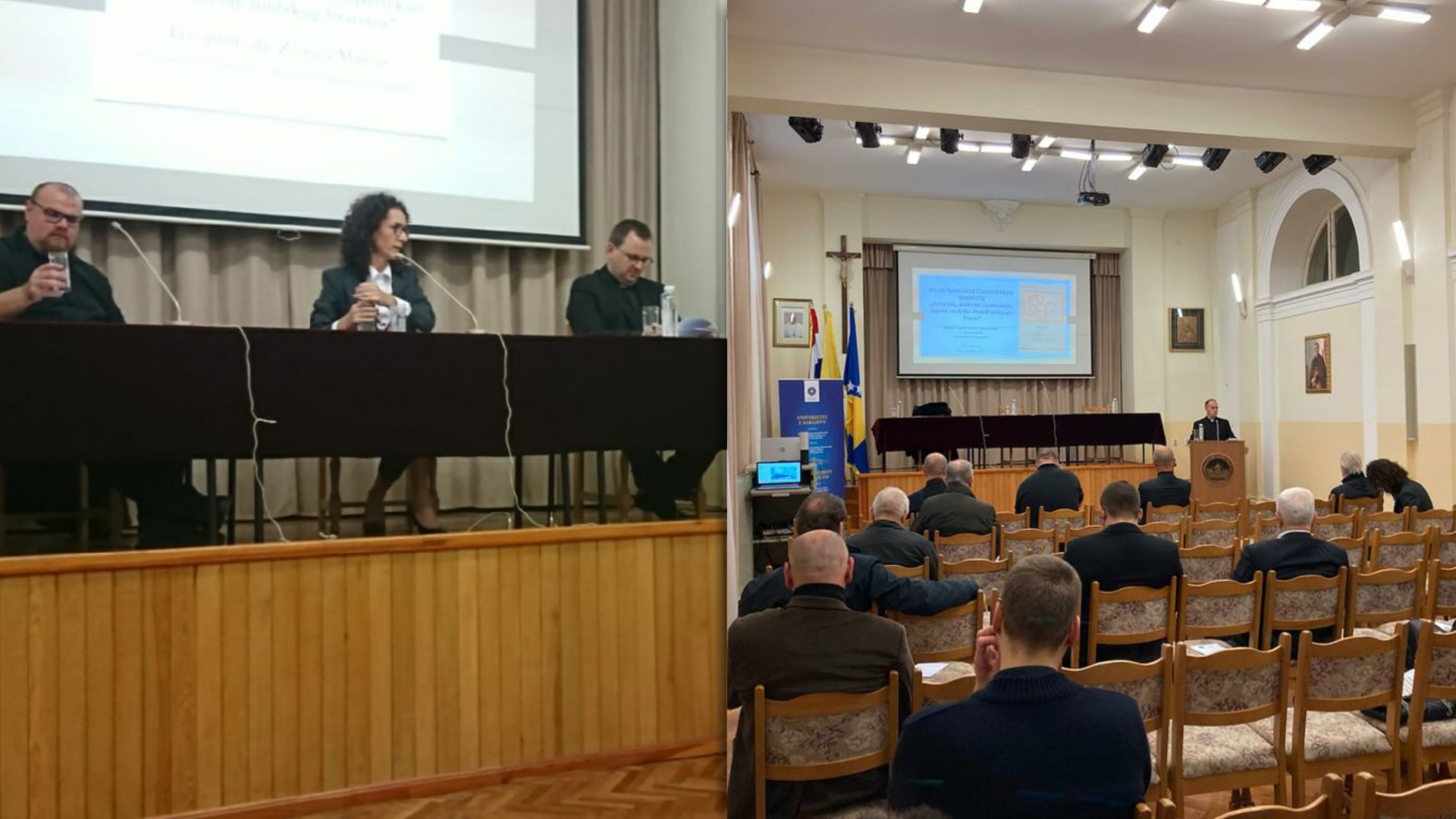
An international academic symposium, “Religious, Social and Cultural Aspects of Pope Francis’ Encyclical Fratelli tutti,” was held at the Catholic Faculty of Theology of the University of Sarajevo on Thursday and Friday, November 11 and 12, 2021. The Student Office of the Sarajevo faculty reported on the two-day event, which was devoted to different dimensions of the Pope’s encyclical.
The program was moderated by Assistant Professor Dr Hrvoje Kalem, professor of fundamental theology at the Catholic Faculty of Theology in Sarajevo. On behalf of the faculty and the organizers, Dean Prof. Dr. Sc. Darko Tomašević welcomed the speakers and everyone in attendance, and also thanked all those who contributed to organizing the symposium.
After several symposia and lectures on Fratelli tutti had been held in the Church among Croats, the Sarajevo Catholic Faculty of Theology wanted to make its own contribution to considering the questions raised by the encyclical. This approach also shaped the breadth of the program: alongside theological themes, the encyclical addresses sociological, political, economic, migration-related and interreligious issues.
Day one: digital communication, fraternity and respect for one’s neighbour
The first presentation, “Digital Communication as a New Way of Life in a Closed World,” was delivered by Assistant Professor Dr Mario Bernadić of the Catholic Faculty of Theology in Sarajevo. He emphasized the extensive development of digital and communication technologies over the past several decades. According to his presentation, these changes have affected not only the way people work and communicate with one another, but also how they think and express themselves culturally.
Associate Professor Dr Boris Vulić of the Catholic Faculty of Theology in Đakovo then spoke on “The Relationship between Universal and Christian Fraternity in the Light of the Encyclical ‘Fratelli tutti.’” He approached the encyclical by asking how universal and Christian fraternity relate to one another in Pope Francis’ teaching. In his discussion, he connected the Pope’s teaching with that of Josef Ratzinger and Karl Rahner.
Prof. Dr. Sc. Nedžad Grabus, listed in the program with FIN Sarajevo and Theology in Ljubljana, delivered the presentation “Faith in God and Respect for One’s Neighbour – A Muslim Perspective.” He stressed that Muslims and Christians share a connecting heritage of tradition in their faith, on which they have developed important questions in the theology of monotheism. He presented the theoretical and practical foundations for dialogue between Muslims and Christians at the personal and institutional levels, particularly in relation to the Catholic Church.
Day two: racism, politics and social friendship
On the second day, Assistant Professor Dr Oliver Jurišić of the Catholic Faculty of Theology in Sarajevo gave a presentation titled “Racism: An Instrument of Power and Forgetting.” He sought answers to several questions: Is racism also an ideological weapon in attempts to erase and reinterpret the past, and does it become an ideology of perpetual repentance and apology? He also asked whether racism had moved from being a social problem to becoming part of an untouchable discourse that manifests itself as power and thereby forbids any possible criticism of itself.
After him, Dr. Sc. Jakov Rađa of the Catholic Faculty of Theology in Zagreb spoke on “The Best Politics in the Service of Universal Fraternity.” He distilled the inspiration that Fratelli tutti seeks to offer politics and politicians into four criteria for renewing political action: interpreting the feelings of the people in order to make the pursuit of the common good possible, promoting a culture of work, giving priority to those who are last, and fostering a spirit of openness to all.
Associate Professor Dr. Sc. Zorica Maros of the Catholic Faculty of Theology in Sarajevo delivered the presentation “Dialogue and Social Friendship as the Realization of Human Fraternity.” She presented the connection between social friendship and fraternity, pointing to Pope Francis’ approach, which equates them.
Migration and a Muslim reflection on the encyclical
After a break and discussion, Associate Professor Dr Pavle Mijović of the Catholic Faculty of Theology in Sarajevo spoke on “Critical Theory of Migration in the Encyclical Fratelli tutti.” He placed the phenomenon of migration at the centre of his presentation, emphasizing that, because of its current and contemporary relevance, it occupies a privileged place in Pope Francis’ thought.
The symposium concluded with the presentation “A Muslim Reflection on the Encyclical Fratelli tutti,” delivered by Assistant Professor Dr Orhan Jašić of FIN in Sarajevo. He presented some of the encyclical’s messages of dialogue from the perspective of Muslim theology and drew attention to the views on this subject of contemporary Muslim author and religious leader Ahmad At-Tayyib.
As stated in the Student Office’s announcement of Friday, November 12, the Catholic Faculty of Theology in Sarajevo wanted through this event to bring the encyclical closer to people by exploring themes that are an integral part of life. The intention was to encompass different dimensions of human reality, while recognizing that this is not simple, and to seek answers to the questions posed in the encyclical. The program was therefore divided into eight main themes that relate directly or indirectly to its main chapters. From their respective scholarly perspectives, the speakers sought to offer answers that would encourage a different view of the human person, relationships between people and the world in which we live.