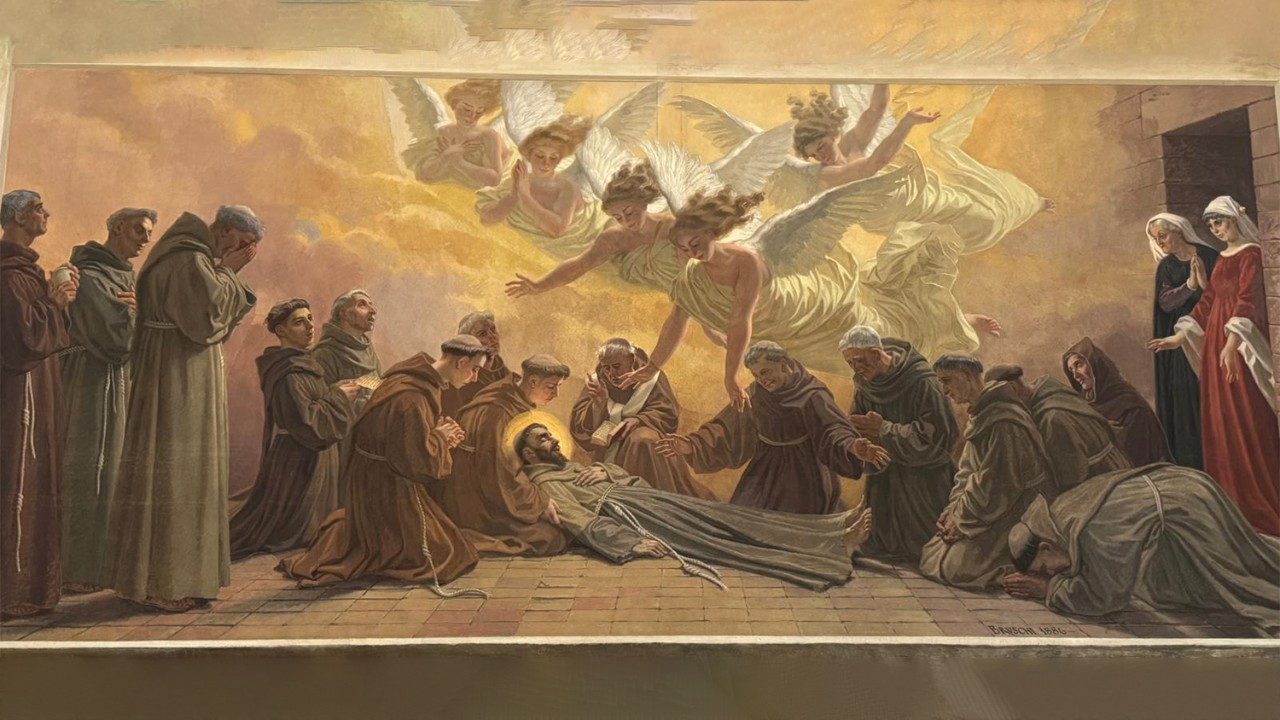
In the year marking the 800th anniversary of the death of St Francis of Assisi, Fra Darko Tepert returns to the saint’s final year and the Testament he wrote then. In a reflection published by Vatican News on 6 October 2026, the Secretary for Formation and Studies at the General Curia in Rome considers Francis’s conversion as a sequence of experiences that gradually reveal the meaning of his vocation.
The reflection is part of a series of Tuesday programmes devoted to major Franciscan anniversaries. From 2023 to 2026, the series follows events from the end of Francis’s life: the confirmation of the Rule, Christmas at Greccio, the reception of the stigmata at La Verna, the composition of the Canticle of the Creatures and, finally, the death of the poor man of Assisi.
The beginning Francis never forgot
When Francis speaks in the Testament about the beginning of his new life, he does not first mention the crucifix at San Damiano, the little churches he rebuilt or the brothers who joined him. He speaks of lepers. While he was living in sin, he testifies, seeing them was exceedingly bitter for him. Then he describes how the Lord himself led him among them, where he showed them mercy. What had been bitter to him before was transformed into sweetness of soul and body.
Tepert sees in this a conversion that did not remain merely in the realm of thought: it took place in an encounter with a body people shunned and a face society kept out of sight. Yet Francis’s recollection contains no self-praise or emphasis on his own courage, nobility or generosity. The Lord is the principal agent: he led Francis among the lepers, gave him faith and brothers, and revealed to him a life according to the Gospel. A person participates, resists and gives assent, but grace comes first, the author stresses.
That is why, in Tepert’s reading of Francis, the question “Who am I?” cannot be separated from “Who are you, Lord?” Identity is not born of self-contemplation in isolation, but in relationship with God and the people one encounters. The anniversary of Francis’s death brings us back to this very beginning: at the end of life, Tepert writes, what remains is the history of relationships in which we have received and given mercy. Francis, who once feared looking at a leper, can look at his own death and call it sister. The author links both acts of looking to the same school of freedom.
From knightly dreams to questions about the value of life
The Legend of the Three Companions and other early biographies present a different picture of the young Francis: his ambitions were directed towards knighthood, honour and social advancement. Tepert situates these ambitions in the atmosphere of a city growing wealthy and a culture in which worth was affirmed through victory. In these sources, historical events and their spiritual interpretation are not separated. The author expresses this tension with the image that “armour can shine, and yet hide a heart that still does not know where it is going.”
He also connects this theme with contemporary people, who can easily build their identity around visible success and belonging to a particular group. At the same time, he warns against confusing the original event with later interpretations. The early biographies seek to show the action of grace in Francis’s life, while contemporary readings additionally highlight the social, ecological or interreligious consequences of his choice.
According to the Legend of the Three Companions and Thomas of Celano’s First Life, war and captivity disrupted Francis’s plans. His defeat in the war against Perugia formed part of the broader development of his vocation and raised the question of what is truly worth living for. The early sources do not present this journey as a plan completed in advance, but as a series of experiences whose meaning gradually becomes clear.
Tepert sees this as an encouragement for understanding crises today as well. Although we often experience them as useless and unpleasant, they can expose false securities and open space for growth. Francis’s example, he emphasises, does not offer a technical solution to a problem, but a pattern of conduct that can be traced through his life.
Mercy is not a feeling at a distance
For Tepert, the encounter with the leper in the opening lines of the Testament (Test 1–3) is at once a concrete act and a symbol of breaking down the boundary between what is pleasing and what is repellent. Mercy is not a feeling at a distance, but drawing close to a person we have previously excluded from our own world. Later iconography often singled out the gesture itself, but the text of the Testament also preserves its significance for human relationships and the life of the Church.
The author links the lasting value of this scene with new forms of invisibility: loneliness, poverty, illness, migration, addiction and every stigma that reduces a person to a number or a problem. The historical encounter thus becomes an impetus to recognise people who are still easily kept out of sight today.
Thomas of Celano’s Second Life and the Legend of the Three Companions particularly emphasise that Francis loves the person from whom he once fled. Francis’s kiss to the leper, Tepert explains, does not romanticise illness, but acknowledges a dignity that fear could not see. The scene appears in biographies, liturgical commemoration and depictions of Francis’s life, although individual sources place different emphasis on it.
According to the author, the contemporary connection lies in the fact that relationships remain superficial as long as we allow closeness only with those who do not disturb our sense of security. Yet this lesson does not erase the differences between historical periods. Knowing the medieval context matters, so that Francis does not become merely a general symbol of goodness, detached from Christ, the Church and a way of life shaped by the Gospel.
Renouncing possessions and the concreteness of prayer
The Legend of the Three Companions and Thomas of Celano’s First Life also describe how Francis, before the Bishop of Assisi, returned his clothes to his father and renounced his inheritance. For Tepert, this is not merely a striking anecdote. He does not interpret the gesture as contempt for family or material things, but as a break with the logic by which possessions determine a person.
Such renunciation, he adds, remains relevant beyond Franciscan communities because consumer culture tells people that they are what they can buy, display and protect. The author sees echoes of this theme in art and literature, as well as in more recent reflections on justice and peace.
In the Testament, Francis also describes the simple prayer he says in churches: adoration of Christ and his cross, through which, as he professes, Christ redeemed the world (Test 4–5). Tepert stresses that faith here is not an abstract idea. It has a place, a posture of the body, words and time. In later Franciscan interpretation, it is precisely kneeling before Christ that exalts the human person.
The author connects this scene with digital distraction, which makes recollection difficult and creates the impression that every silence is emptiness. The anniversary of Francis’s death, which is also the anniversary of the writing of his Testament, therefore gives him an occasion to call for adoration wholly focused on Christ and his saving work.
Brothers as a gift, not a project
In the Testament, Francis also bears witness that the Lord gave him brothers whom he had not chosen himself (Test 14–15). Tepert recognises the arrival of the brothers as the beginning of a new stage in Francis’s life: the vocation takes shape in relationship with real people, with their gifts and weaknesses. For Francis, a brother is not a project, but a gift that calls for patience.
This idea matters today too, the author points out, because it is easy to love an imagined community, but harder to remain faithful to people who do not match our expectations and do not speak or act as we expect. He again recalls the historical context: Francis’s acceptance of the brothers took place in 13th-century communal Italy, in a culture marked by strong class distinctions that were also present in the Church.
At the end of his life, Francis returns once more to the lepers in the Testament. Tepert sees this not as a mere biographical detail, but as the key with which the saint interprets his entire journey. The first encounter is not an episode he outgrew: later Franciscan tradition understood the direction of his life precisely through this humble beginning. Circumstances today are different, the author concludes, but we too need to return to our original experiences in order to distinguish vocation from later habits and roles.